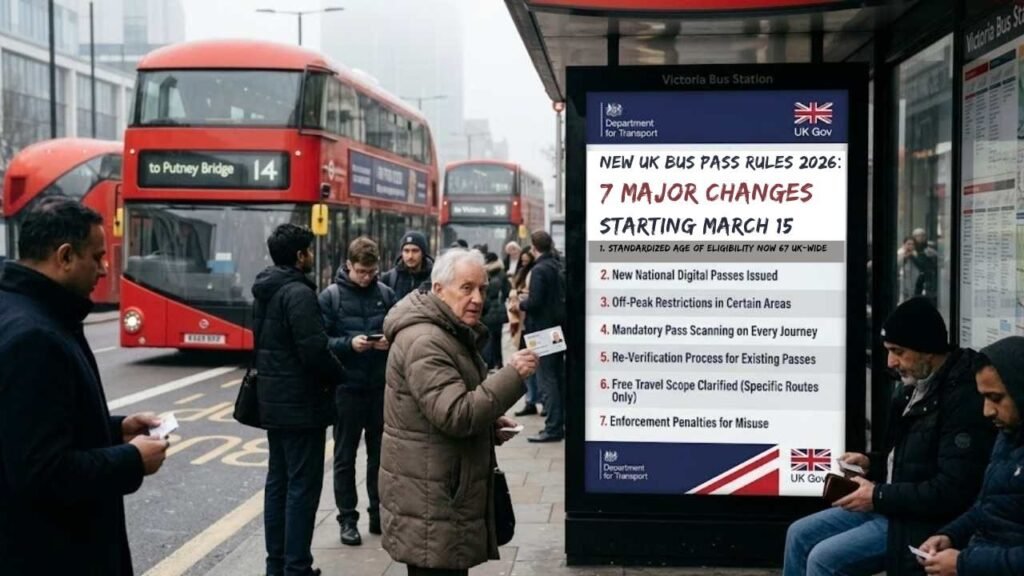
The landscape of public transportation for older residents in England is shifting as the government aligns travel benefits with retirement age. Starting on 25th March 2026, new administrative and eligibility guidelines will begin to influence how thousands of passengers access free local bus services.
Understanding the Shift in Eligibility Age
The most significant change affecting passengers is the continued adjustment of the qualifying age for an older person’s bus pass. In England, the right to free off-peak bus travel is legally tied to the State Pension age rather than a fixed birthday like 60 or 65. As the pension age moves toward 67, the window for when a resident can first apply for their pass is also being pushed back.
This means that individuals who were looking forward to receiving their pass at 66 may find they are now required to wait until their 67th birthday to qualify. The transition is designed to ensure the National Concessionary Travel Scheme remains financially sustainable as the population ages and life expectancy figures fluctuate.
Regional Variations Across the United Kingdom
It is important for travelers to recognize that these specific timing changes largely impact those living in England. The United Kingdom does not have a single, unified bus pass system, and the devolved nations maintain their own sets of rules regarding who can travel for free and when.
- Scotland and Wales continue to offer free bus travel to residents starting at age 60.
- Northern Ireland provides similar benefits for those aged 60 and over through the SmartPass scheme.
- London residents can still access a 60+ Oyster photocard for free travel within the capital.
- Local councils in England may choose to offer their own discretionary schemes for younger seniors.
Because these rules are not uniform, a pass issued in one part of the country may not be valid for travel in another. Passengers are encouraged to check the specific boundaries of their pass before planning long-distance trips that cross regional borders.
Standard Hours and Peak Time Restrictions
While the eligibility age is rising, the standard hours of operation for the national scheme remain largely consistent. Most concessionary passes are valid for off-peak travel, which helps prevent overcrowding during the busiest times of the morning.
- Travel is generally permitted between 9:30 am and 11:00 pm on weekdays.
- Pass holders can usually travel all day on Saturdays, Sundays, and bank holidays.
- Some local authorities allow disabled pass holders to travel before 9:30 am for medical appointments.
The government has reiterated that local councils have the power to expand these hours if they have the budget to do so. However, due to rising costs, many councils are strictly enforcing the 9:30 am start time to manage their transport subsidies effectively.
Digital Updates and Renewal Procedures
As part of the March 2026 updates, there is a push toward more digital-friendly systems for managing bus passes. Local authorities are being encouraged to move away from paper-heavy application processes in favor of online portals that allow for faster identity verification.
This shift aims to reduce the amount of fraud within the system and ensure that passes are only held by those who currently meet the residency and age requirements. If your pass is nearing its expiration date, you may be asked to provide updated digital proof of address or a recent photograph to ensure the smart card technology remains functional at bus readers.
Future Outlook for Concessionary Travel
The changes taking place this year are part of a longer-term strategy that will see the State Pension age—and consequently the bus pass age—increase further in the coming decades. While the current focus is on the move to age 67, further adjustments are expected as the government balances the high cost of the scheme against its undeniable social benefits.
Free bus travel is widely recognized as a lifeline for older people, helping to combat social isolation and providing access to essential services like healthcare and grocery shopping. Even with the later start date, the scheme remains a cornerstone of the UK’s commitment to supporting its senior population.