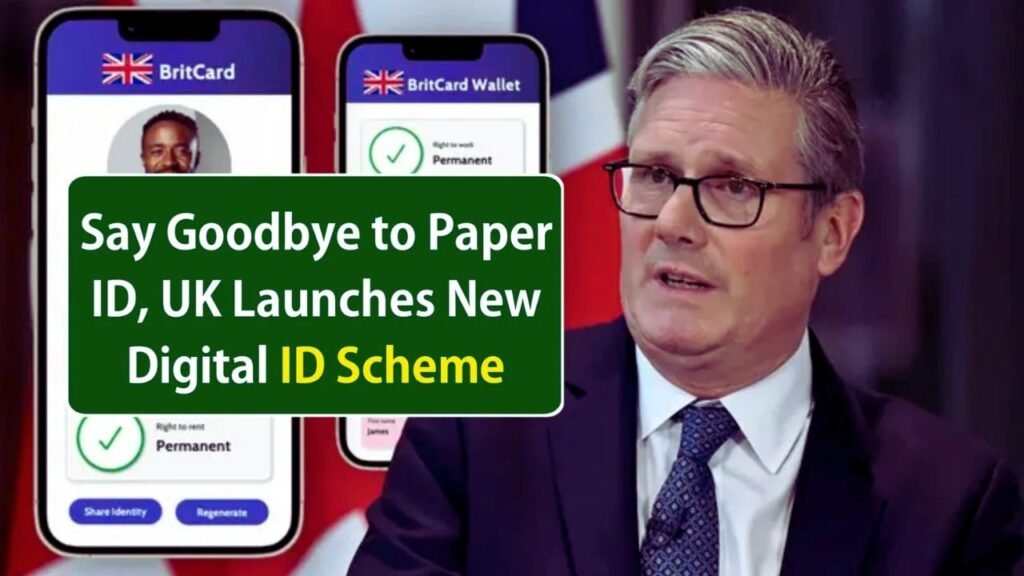
The United Kingdom is taking a definitive step toward a paperless future with the official unveiling of a new national digital identity scheme. Announced in March 2026, the initiative aims to modernize how citizens interact with the state, moving away from a reliance on physical documents like birth certificates and utility bills toward a unified, secure app-based system.
The Shift Toward “Government by App”
The core of the new scheme is the ambition to create a “single source of truth” for identity that resides on a user’s smartphone. By integrating various government services into one platform, the Treasury and the Cabinet Office hope to eliminate the frustration of multiple logins and the constant need to scan paper proofs of address.
- Users will be able to store digital versions of government-issued credentials in a secure GOV.UK Wallet.
- The system is designed to work as seamlessly as online banking, allowing for instant identity verification.
- A prototype of the app has already been showcased, featuring “selective disclosure” technology.
- This technology allows a person to prove they are over 18 without revealing their exact date of birth or home address.
Government officials have framed this move as a way to catch up with the private sector, where digital interactions are already the standard. The new digital ID is expected to significantly reduce bureaucracy and speed up applications for everything from universal credit to renewing a driving license.
Digital Right to Work and Employment Changes
One of the most immediate impacts of the new scheme will be felt by those starting new jobs. The government has confirmed its intention to make digital “Right to Work” checks a mandatory standard by the end of the current Parliament. While paper passports and eVisas will still be accepted for those who prefer them, the new digital ID will become the primary, fastest route for employers to verify a candidate’s eligibility.
- The new digital proof of identity will be used to streamline the hiring process for both British citizens and foreign nationals.
- Employers who utilize the certified digital verification services (DVS) will benefit from a “statutory excuse” against illegal working fines.
- The scheme aims to tackle identity fraud by using biometric face-matching technology within the GOV.UK ID Check app.
- Small businesses are expected to save thousands of hours annually by moving away from manual document checking.
The government has also introduced the “UK CertifID” trust mark. This official seal will help businesses and individuals easily recognize which digital ID providers meet the strict security and privacy standards set by the state.
Privacy, Inclusion, and the National Consultation
Despite the technological push, the government has emphasized that the digital ID will not be a compulsory “ID card” in the traditional sense. It is being designed as an optional tool that people will want to use rather than one they must have. To ensure the system is trusted and inclusive, a major eight-week national consultation has been launched, running until 5th May 2026.
- A “People’s Panel” will be established to discuss the ethics of data storage and privacy.
- The consultation will specifically address the minimum age for a digital ID, with proposals ranging from age 13 to 16.
- There are ongoing debates about how to support residents in rural areas with poor mobile coverage.
- Alternative physical access routes will remain available for those who are not “digitally savvy” or do not own a smartphone.
Civil liberties groups have raised concerns about the potential for “function creep,” where a voluntary ID slowly becomes mandatory for everyday activities. In response, ministers have reiterated that there will be no centralized database of all citizens’ identities, with data instead being encrypted and stored locally on the user’s device.
The Roadmap for Future Integration
Looking ahead, the digital ID scheme is expected to expand into the private sector. By late 2026 and into 2027, the government hopes to see the ID used for age-gated purchases in supermarkets and for verifying identity when moving house or opening a bank account.
The ultimate goal is a “Rewired State” where public services are proactive rather than reactive. By 2027, all central government services are expected to be onboarded to the “One Login” system, creating a truly digital relationship between the citizen and the state. This transition marks the beginning of the end for the “scramble for a utility bill” that has defined British bureaucracy for decades.
Frequently Asked Questions
Is the new digital ID mandatory for everyone?
No. The government has explicitly stated that there is no legal obligation to have or present a digital ID. While some checks (like Right to Work) must be done digitally, you can still use traditional documents like a physical passport or an eVisa to fulfill those requirements.
Will I still need a physical driving license?
For now, yes. While the Digital Driving Licence is being integrated into the GOV.UK Wallet, you should keep your physical photocard as a backup, especially if you plan to drive abroad where digital versions may not yet be recognized.
What happens if I lose my phone?
The digital ID is protected by the same security measures as your banking apps, including biometrics and encryption. Because there is no centralized database, your identity cannot be “stolen” from a government server; you would simply need to re-verify your identity on a new device using your original photo ID.
Can a 13-year-old get a digital ID?
This is currently being decided through the national consultation. The government is considering allowing younger teens to have a limited digital ID to help with age verification for social media and online safety, but the final age limit has not been set.
Does this mean the UK is getting ID cards?
The government describes this as a “digital identity” rather than a physical ID card. The main difference is the lack of a central database and the fact that it is a digital credential stored on your own device that you choose when and where to share.